
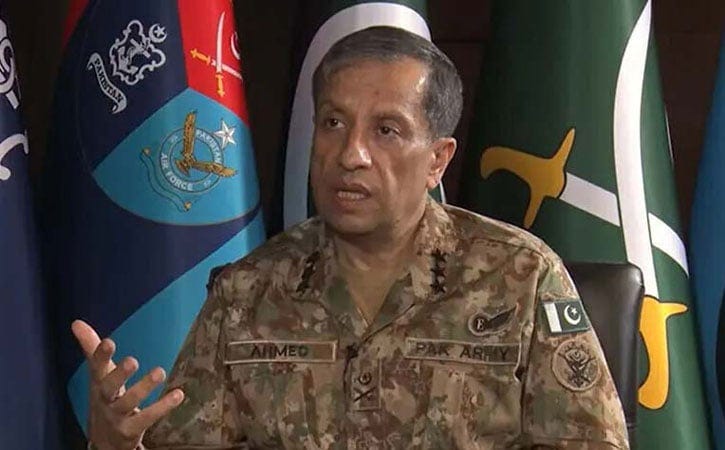
ISLAMABAD — Pakistan’s military spokesman on Tuesday issued direct political statements during a lengthy press conference, prompting criticism from opposition figures and legal experts, who said the remarks once again underscored the military’s direct involvement in Pakistan’s politics.
Lieutenant General Ahmed Sharif Chaudhry, Director General of Inter-Services Public Relations (DG ISPR), used the briefing to accuse former prime minister Imran Khan and his party, Pakistan Tehreek-e-Insaf (PTI), of encouraging instability and maintaining links to violent elements, according to excerpts circulated by state media.
The press conference, which lasted more than three hours, went beyond the military’s traditional remit of operational and security matters, addressing issues ranging from internal party governance within PTI to ongoing court cases involving opposition leaders.

Political reactions
Senior opposition figures reacted sharply, saying the military spokesman’s comments amounted to political interference.
Former federal minister Javed Hashmi said the briefing showed the military was continuing what he described as “political operations under the cover of security messaging,” adding that past counterterrorism campaigns had failed to deliver lasting stability despite repeated military operations.
Leaders from PTI also issued a written response, rejecting the allegations and accusing the military of attempting to shift responsibility for Pakistan’s security challenges onto political opponents. The party said linking PTI to militancy was a “recycled narrative” used to justify crackdowns on dissent.
Legal concerns over sub judice matters
The press conference has also drawn scrutiny from legal circles after the DG ISPR displayed social media posts and photographs of opposition figures, including lawyer and activist Iman Mazari, whose cases are currently under trial.
Mazari’s legal team told the court that the military spokesman’s remarks prejudiced judicial proceedings, arguing that the statements constituted commentary on sub judice matters by a senior state official. Lawyers requested the court to summon the DG ISPR to substantiate the allegations made during the briefing.
The judge deferred the request, placing the petition on hold until later stages of the trial, according to court officials.

Military operations and internal security
During the briefing, the military’s spokesman defended the armed forces’ counterterrorism strategy, saying decisions on security operations were taken in the national interest. He said the military had conducted dozens of large-scale operations and thousands of targeted actions against militant groups over the past decade.
Political leaders from Khyber Pakhtunkhwa province, however, said repeated security operations had imposed significant social and economic costs on local communities. They accused authorities of excluding elected representatives and tribal elders from key decision-making processes.
Khyber Pakhtunkhwa Chief Minister Sohail Afridi said any future security policy should be formulated through consultation with provincial stakeholders to ensure sustainable peace. He also questioned the effectiveness of continued military operations, arguing that if more than 14,000 operations had failed to bring lasting peace, there was no clear guarantee that further operations would succeed.
Analysts said the tone and substance of the press conference reflected growing tensions in Pakistan’s civil–military landscape.
“The military spokesman is increasingly addressing political narratives directly, which raises questions about institutional boundaries,” said one Islamabad-based constitutional expert, speaking on condition of anonymity. “In most democracies, such disputes would be left to civilian authorities and courts.”
The military has rejected accusations of political interference in the past, saying it supports constitutional order and internal stability.
Broader political backdrop
The press conference comes amid heightened political tension in Pakistan, where former prime minister Imran Khan remains in custody and has been held in isolation, and where military authorities have refused to allow his sister to meet him despite a court order. Several senior leaders of his party, Pakistan Tehreek-e-Insaf (PTI), have also recently received lengthy prison sentences in cases linked to protests and unrest last year.
The United Nations and international human rights organisations have raised concerns over restrictions on political activity, Khan’s continued detention, curbs on media freedoms, and the alleged use of military courts or military influence in civilian legal processes.