
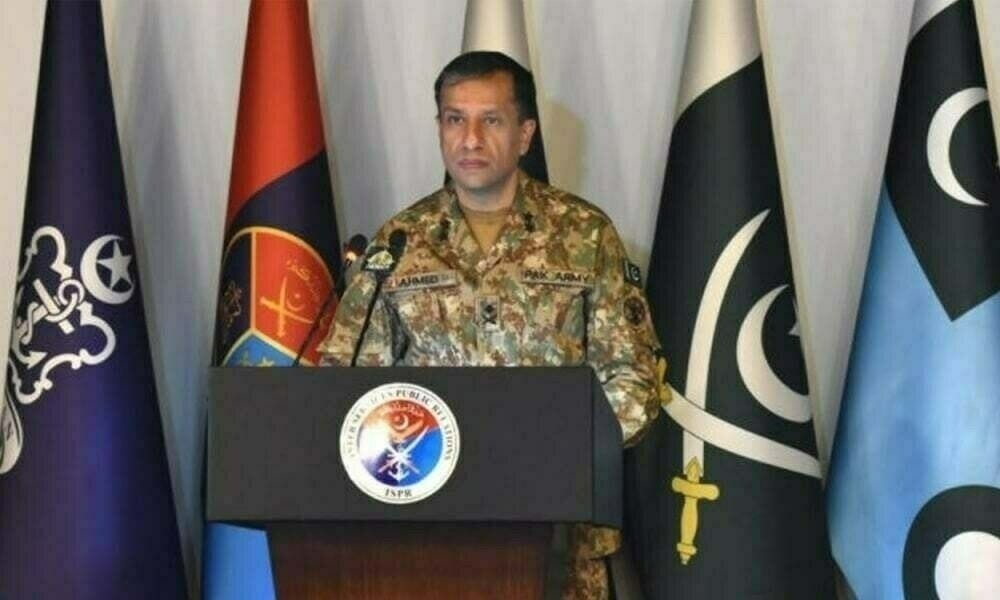
When the DG ISPR stepped up to the podium on December 5, the country expected a standard security briefing. Instead, what followed was a highly charged, politically loaded message that sent shockwaves through Pakistan’s social platforms. Prominent journalists and analysts immediately recognized the tone: this was not institutional communication — it was political confrontation.
Following the issuance of the new CDF notification for the Army Chief Asim Munir, the 5 December press conference appeared to be a standard security briefing, but its message revealed a far deeper political shift underway. The language was emotional, defensive, and unmistakably political. Instead of explaining external threats, operational matters, or why Pakistan went a full week without an officially notified Army Chief due to delays caused by the military’s political allies, the press conference pivoted toward a far more political narrative. The briefing centered on “narratives,” criticism, and alleged “internal destabilization.” These are not the words of a neutral institution; they are the vocabulary of a political actor seeking to reassert control.
Across Pakistan’s digital landscape, analysts interpreted the briefing as an attempt to redefine dissent — especially the dissent associated with Imran Khan’s supporters — as a national security threat. This reframing serves a clear purpose: it allows the state to justify extraordinary measures, expand its authority over civilian affairs, and delegitimize a political movement that continues to command public loyalty.
Prominent voices across Pakistan’s media bluntly argued that the press conference was tailored to serve the political needs of the Asim–Sharif–Zardari power bloc, fitting seamlessly into the agenda of a regime increasingly reliant on military dominance to sustain itself. As the ruling coalition struggles to regain public trust, it has grown increasingly dependent on the military’s institutional power. The DG ISPR’s tone, timing, and message reinforced that political alignment, signaling a coordinated effort to contain the influence of Khan’s political base.
What makes this briefing particularly significant is not what was said, but what it reveals. Despite arrests, censorship, party fragmentation, and legal pressure, Imran Khan remains the most influential political figure in the country. His narrative continues to dominate public discourse, and his support base remains remarkably resilient. For the political system and security establishment, this is an unprecedented challenge — a mass movement that refuses to dissipate under repression.
The result is a familiar pattern resurfacing in a new form. For 78 years, Pakistan’s power structure has oscillated between civilian governments and military authority. Whenever public opinion becomes unpredictable or a leader grows too popular, the establishment intervenes to regain control — sometimes through direct rule, sometimes through political engineering, sometimes through judicial manipulation. The 5 December press conference fits squarely into this legacy.
By using a national security platform to address political criticism, the DG ISPR blurred the boundary between military communication and political messaging. This is not a retreat from politics; it is an expansion of political engagement by the institution that already holds decisive influence over national affairs.
What emerged from the briefing was a clear warning: the state is preparing for a more assertive phase of political management. Dissent will be recast as subversion, public opinion as manipulation, and political movements as “threats.” The narrative is shifting — and it is shifting intentionally.
Pakistan has reached another pivotal moment in its long struggle between democratic aspiration and institutional dominance. The DG ISPR may have spoken in the name of stability, but the speech exposed something deeper: a system unwilling to trust its citizens, and a leadership afraid of the very public it claims to protect.