
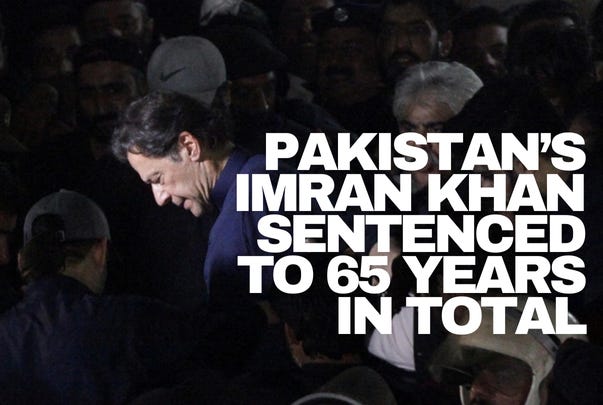
ISLAMABAD — The cumulative prison sentences handed to Pakistan’s jailed former prime minister Imran Khan now amount to what his supporters describe as a political life term, deepening a domestic crisis that coincides with sensitive foreign-policy manoeuvring over Gaza and unusually blunt disclosures by U.S. officials.
This week, a trial court sentenced Khan and his wife Bushra Bibi to a further 17 years each in the Toshakhana-II case, taking Khan’s total sentences across multiple convictions to roughly 60–65 years. In his written verdict, the judge said he was being “lenient” due to Khan’s age and Bushra Bibi being a woman — language critics say underscores the punitive tone of the ruling rather than judicial restraint.
The case centres on a Bulgari jewellery set received from the Saudi royal family in 2021. Prosecutors argue the gift was undervalued, improperly deposited in the state Toshakhana repository, and unlawfully retained. Khan’s defence maintains he paid the officially assessed amount through the prescribed mechanism, and that if the valuation was flawed, liability rests with officials who conducted it. Lawyers also argue that the offence relied on 2023 legal amendments, applied retroactively to conduct that occurred in 2021 — a move they say violates basic principles of criminal law.
Procedural questions have further fuelled controversy. After months of adjournments, defence lawyers were informed late at night that the court would sit the next morning. Final arguments were not completed, only one defence lawyer was allowed inside the jail courtroom, and family members were barred. The judge is reported to have arrived with a pre-written 65-page judgment, read it out, and left without addressing next legal steps. Earlier observations by the Islamabad High Court had already questioned what law in force at the time made non-deposit of gifts a criminal offence — reasoning that had appeared to favour Khan.
Khan’s supporters say the case illustrates selective accountability. They point to past instances where political leaders allegedly retained state gifts or vehicles without similar prosecution, and to the military’s own opaque handling of gifts, which does not fall under Toshakhana rules. Authorities deny political targeting and insist the courts are acting independently.
From jail, Khan responded calmly, according to aides and journalists with access. He smiled on hearing the verdict, instructed his lawyers to appeal, and reiterated that his struggle was rooted in rule of law rather than personal grievance. He again drew a distinction between Pakistan’s armed forces as an institution and what he calls a small group of senior generals misusing power, warning that framing the conflict as “PTI versus the army” would only entrench those at the top.
That warning has gained traction as domestic repression increasingly intersects with foreign-policy disclosures. Several journalists and analysts who closely track Pakistan’s civil–military relations say the removal of former prime minister Imran Khan was driven in part by strategic disagreements with Washington, including his government’s refusal to align with the Abraham Accords framework and its resistance to granting the United States expanded military basing or access arrangements in Pakistan. A Reuters report earlier said Pakistan had offered to contribute troops to a proposed post-war stabilisation force in Gaza. The issue escalated when U.S. Secretary of State Marco Rubio, during a press briefing, stated publicly that Pakistan itself had initiated the offer — a disclosure that contradicted the Pakistani government’s initial efforts to downplay or blur the report, and underscored claims by Khan’s supporters that foreign-policy realignment played a role in the regime-change operation against him.
More:

Subsequently, senior ruling-party Pakistan Muslim League Nawaz Group (PMLN) figure Rana Sanaullah confirmed that army chief Asim Munir was on a foreign tour that included the United States, undercutting earlier Foreign Office claims that no such engagement was taking place. Analysts say Rubio’s remarks effectively exposed the military leadership’s role in quiet coordination with Washington, bypassing civilian transparency.
Against this backdrop, critics argue the unusually severe sentencing of Khan — amounting in aggregate to a lifetime behind bars — serves a dual purpose: neutralising the country’s most popular political challenger while smoothing the path for sensitive external alignments by minimising domestic resistance. Some commentators have linked the timing and severity of the judgments to efforts to consolidate authority as Pakistan positions itself as a security partner in a volatile Middle East, including Gaza. The military denies any connection between domestic legal cases and foreign policy.
Religious and ideological messaging has also shifted. Senior clerics have issued carefully calibrated statements supporting Gaza’s reconstruction while rejecting any role in disarming Palestinian resistance — positions critics describe as scripted to balance domestic sentiment with international expectations. They note that Pakistan’s establishment has repeatedly reshaped its ideological posture over decades, from Cold War ally to jihad-era partner to contemporary strategic collaborator, depending on geopolitical need.
For Khan’s supporters, the Toshakhana-II verdict is not an isolated legal outcome but part of a broader strategy of political neutralisation: compressed trials, retroactive laws, selective enforcement and information control at home, paired with strategic repositioning abroad. The risk, they warn, is deepening polarisation and erosion of the rule of law — while public anger is redirected away from individual decision-makers and toward institutions themselves, a dynamic Khan has repeatedly cautioned against.