
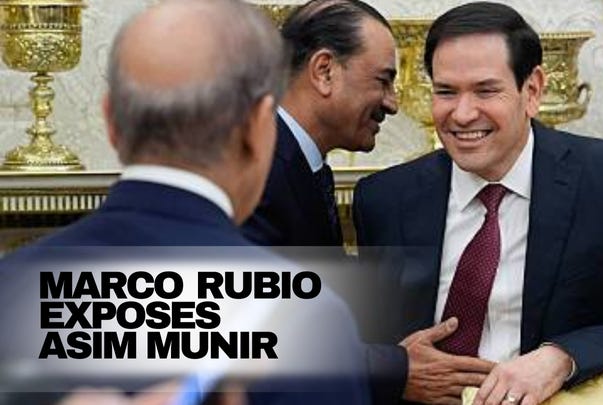
ISLAMABAD/WASHINGTON — Pakistan’s offer to contribute troops to a proposed multinational stabilization force in Gaza has brought into sharp focus the country’s dual-track strategy: projecting cooperation abroad while tightening political and security controls at home.
U.S. Secretary of State Marco Rubio said this week that Pakistan had offered to participate in a post-war security force for Gaza, adding that Washington was reviewing the proposal and working through issues related to mandate, procedures and rules of engagement.
“We’re grateful to those countries, including Pakistan, that have offered troops,” Rubio told reporters in Washington, saying discussions were continuing over authorization and operational parameters.
The remarks publicly confirmed Pakistan’s willingness to engage in a U.S.-backed security framework tied to Gaza — a disclosure that contrasted with more cautious statements from Islamabad, where officials have said no final decision has been taken.
From pressure claims to proactive offer
Until recently, Pakistani officials and allied media had suggested that Army Chief Asim Munir was under pressure from the United States to deploy Pakistani troops to Gaza. However, recent statements by U.S. officials have clarified that no such coercion was applied. Instead, Pakistan’s civilian and military leadership, including Prime Minister Shehbaz Sharif, had proactively offered the services of the Pakistani army as part of a proposed multinational force, a move analysts say was aimed at securing external support amid mounting domestic political and legal challenges.
External signalling
Security analysts say Rubio’s comments effectively clarified that Pakistan’s role was not the result of coercion but of an offer, aimed at reinforcing the military leadership’s standing with Washington at a time of regional instability and economic pressure.
Pakistan’s army chief, Field Marshal Asim Munir, is expected to engage U.S. military counterparts in discussions focused on regional security coordination, according to officials familiar with the matter. Diplomats say Pakistan’s army is viewed as an acceptable contributor to a stabilization force, amid Israeli reservations about the involvement of some regional militaries.
Such engagement, analysts say, serves as external validation for Pakistan’s military leadership, strengthening its diplomatic leverage with Western partners.
Domestic containment
At home, however, the Gaza discussions have coincided with a sharp escalation in legal action against political opponents, particularly the opposition Pakistan Tehreek-e-Insaf (PTI).
On Friday, an anti-terrorism court handed down 10-year prison sentences to several senior opposition figures in cases linked to violence following unrest on May 9, 2023. Those convicted included former Punjab health minister Yasmin Rashid, Senator Ejaz Chaudhry, former provincial minister Mian Mahmood Rashid, and former Punjab governor Umar Sarfaraz Cheema.
Former foreign minister Shah Mahmood Qureshi was acquitted in one case, with the court citing his absence from Lahore during the unrest.
The opposition PTI, led by jailed former prime minister Imran Khan, has described the prosecutions as politically motivated. The government denies interference in judicial proceedings.
Why the two tracks intersect
Analysts say the timing of the verdicts is not incidental. Any Pakistani military role in Gaza risks triggering domestic backlash in a country where public sympathy for Palestinians is strong and suspicion of cooperation with U.S.- or Israel-linked initiatives runs deep.
To manage that risk, they say, the state has moved to pre-empt mass mobilisation by neutralising opposition leadership and signalling zero tolerance for street protests.
“The external message is reliability and control,” said one Islamabad-based analyst. “The internal message is deterrence.”
Recent security actions against religious groups, including confrontations involving Tehreek-e-Labbaik Pakistan (TLP) near Muridke earlier this year, are also seen as part of the same strategy — demonstrating the state’s capacity to suppress unrest that could complicate sensitive foreign policy decisions.
More

Political implications
Together, the Gaza diplomacy and domestic crackdown illustrate how Pakistan’s civil-military leadership is synchronizing foreign engagement with internal enforcement.
Externally, cooperation with Washington bolsters international legitimacy and strategic relevance. Internally, court verdicts, policing, and legal pressure limit the ability of opposition forces to challenge decisions made at the security level.
Whether Pakistan ultimately deploys troops to Gaza remains uncertain. What is clearer, analysts say, is that the leadership is consolidating authority at home precisely as it seeks to expand strategic alignment abroad — a linkage that underscores the shrinking space between foreign policy and domestic politics in Pakistan.