
News Summary:
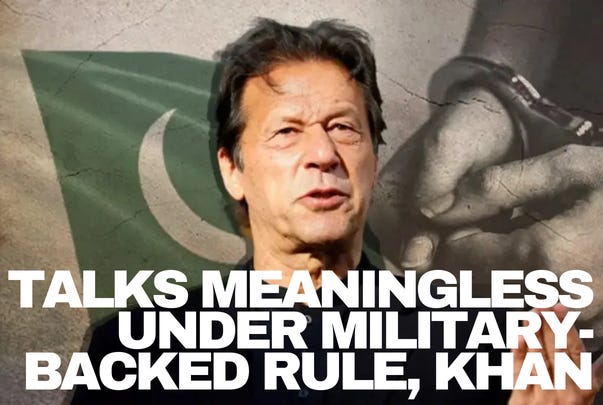
ISLAMABAD — Pakistan’s imprisoned former prime minister Imran Khan has rejected negotiations with the ruling coalition, even as the Pakistan Muslim League-N signals openness to dialogue, highlighting deepening political paralysis and renewed scrutiny of the military’s role in civilian affairs.
The government has previously issued multiple calls for talks, but political analysts say the joint administration led by the Sharif and Zardari families lacks both the electoral mandate and political authority to hold substantive negotiations with Khan’s Pakistan Tehreek-e-Insaf (PTI). Analysts add that past offers of dialogue by successive governments were often aimed at preventing opposition-led street protests rather than addressing underlying political disputes.
During earlier contacts, PTI set conditions for negotiations, including the release of 75-year-old party leader Yasmin Rashid, who was later sentenced to 10 years in prison in cases linked to the May 9 unrest. PTI also demanded permission for senior party figures to meet Khan in custody.
According to journalist Muneeb Farooq, who is widely regarded as close to the military establishment, restrictions on meetings with Khan are not based on legal grounds but reflect a decision taken by the military.
Public statements from Khan’s family and senior figures within his Pakistan Tehreek-e-Insaf (PTI) indicate that any talks with the current government would lack his approval. His sister, Alima Khan, said those advocating negotiations did not represent Khan’s position, reiterating that the former premier had instead instructed party organisers to prepare for a street mobilisation, particularly in Khyber Pakhtunkhwa.
The government, led by Prime Minister Shehbaz Sharif, has publicly suggested dialogue as a means to ease political tensions, but analysts note that the stated preconditions floated by opposition figures — including fresh elections, an inquiry into the 2024 polls, and changes to the election commission — are unlikely to be accepted by the ruling alliance.
Prison stance hardens
Imran Khan has been incarcerated since 2023 in a series of cases ranging from corruption to charges linked to unrest following protests on May 9, 2023. PTI leaders and allied commentators continue to describe the May 9 cases as politically motivated, a claim rejected by the authorities. Courts have so far upheld multiple indictments, while appeals remain pending.

Khan has repeatedly called for an independent judicial inquiry into the May 9 violence and demanded that closed-circuit television (CCTV) footage from the affected sites be made public. He has alleged that the footage was stolen, arguing that those responsible for its removal were the same actors who orchestrated the violence. Despite the passage of nearly three years, no independent investigation into the May 9 events has been conducted.
From prison, Khan has maintained a confrontational posture, rejecting calls for compromise and framing his detention as part of a broader pattern of military interference in politics — a charge Pakistan’s armed forces deny.

Military and intelligence scrutiny
Renewed debate over civil–military relations has been driven by discussion surrounding former intelligence officials and anonymous social-media activity. Commentators have pointed to the now-deactivated X (formerly Twitter) account “Ammar Solangi,” which frequently posted aggressive commentary targeting journalists, activists and judges.
Several journalists have alleged that the account had links to individuals within the security establishment, including references to senior military intelligence officer Faisal Naseer. No official confirmation has been provided, and the military has not publicly commented on the account’s operation. The account’s deactivation has intensified speculation, though the claims remain unverified.
Political analysts say that the emergence of alleged links between the Ammar Solangi account and Faisal Naseer, followed by the account’s sudden shutdown, has also fuelled perceptions of internal divisions within the military, with rival groupings engaged in behind-the-scenes power struggles. According to these analysts, Faisal Naseer is considered to be among the contenders in the race for the post of director general of the Inter-Services Intelligence (ISI), though they say the Sharif family is opposed to his appointment.
Analysts also note that the Ammar Solangi account had been identified and discussed by multiple commentators in the past, but it was only after journalist Muneeb Farooq — who is widely seen as presenting the military’s perspective — publicly pointed to the account that it was taken offline.
Separately, analysts say the ongoing legal proceedings against former intelligence chief Faiz Hameed — whose cases could expand to include matters linked to the May 9 unrest and earlier political events — have deepened uncertainty within Pakistan’s power structure. Claims that Hameed could testify against former prime minister Imran Khan have been described by some of his alleged associates as unfounded, and no court filings to that effect are publicly available.
Broader implications
The standoff comes amid wider concerns over democratic backsliding and declining human-development indicators. According to United Nations data, Pakistan’s Human Development Index ranking has continued to fall in recent years, adding economic pressure to an already volatile political environment.
For now, Pakistan appears locked in a familiar cycle: a government facing legitimacy questions, an opposition leader wielding influence from prison, and a military establishment accused — again — of shaping outcomes. Whether this confrontation moves toward negotiation or escalates into mass protest remains uncertain.