
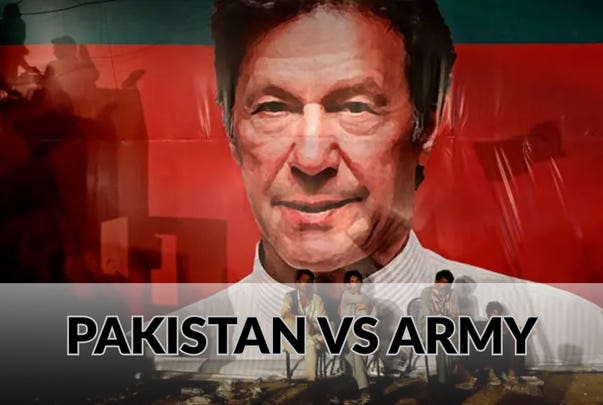
Imran Khan has never been a conventional political actor. Even from prison, he continues to shape Pakistan’s political conversation in ways few leaders before him have managed. More than two years after his removal from office following a military–Sharif–Zardari regime-change operation and his subsequent incarceration, Khan remains physically absent yet politically omnipresent—an anomaly in Pakistan’s long civil–military history.
Since 2023, the former prime minister has been held in a high-security facility, facing more than a hundred legal cases ranging from corruption to charges framed as threats to national security. This is not the first time Pakistan’s military establishment has intervened directly in politics by reclassifying a civilian political leader as a security risk or an internal enemy. Historically, such labeling has functioned less as a judicial determination and more as a political tool—one that shifts dissent from the civilian arena into the security domain, where legal safeguards are weaker and exceptional measures are more easily justified.
The sheer volume of litigation has effectively immobilized Imran Khan, tying him down through continuous court proceedings, restrictions, and prolonged incarceration. Yet immobilization has not resulted in political erasure. On the contrary, confinement has amplified his symbolic power. Removed from public life but not from public consciousness, Khan has become a focal point of national anxiety, resistance narratives, and institutional confrontation.
His imprisonment has transformed him from an active political operator into a political symbol—one onto which competing interpretations of power, legitimacy, and authority are projected. For supporters, his detention reinforces the perception of a leader punished for defiance rather than wrongdoing. For the state, his continued relevance underscores the limits of coercion in neutralizing popular political figures. In this space between power and popularity, the struggle has not ended; it has merely changed form, relocating from electoral politics to prisons, courtrooms, and the broader contest over narrative control.
A Sudden Silence, and a Wave of Alarm
For months, Khan’s imprisonment followed a predictable rhythm. Weekly meetings with lawyers, family members, and party representatives functioned as a controlled channel of communication—allowing updates, messages, and political signals to trickle out. That routine abruptly ended when authorities suspended these meetings for several weeks.
more: Weekly Think-Tank Memo: Pakistan Political, Economic, and Security Review
The silence triggered an immediate reaction. Rumors spread rapidly across social media: claims of torture, deteriorating health, even death. What made the episode unusual was not just the speed of the speculation, but its reach. Concern extended beyond Khan’s core supporters to critics and political neutrals, reflecting a broader unease about the opacity of state power and the treatment of political detainees.
The military establishment and Sharif-Zrdari government eventually permitted meetings with Khan’s sisters, defusing the most extreme rumors. But the damage was done. The episode reinforced suspicions that the state had both motive and incentive to permanently neutralize a political figure it could neither co-opt nor silence.
From Political Rival to “National Security Threat”
Khan’s response was characteristically confrontational. Messages attributed to him following the meetings were sharply critical of the military leadership, singling out Army Chief General Asim Munir. Soon after, the military’s media wing convened an unusually high-profile press conference, attended by prominent journalists.
The tone marked a clear escalation. Khan was no longer framed merely as a political dissenter or convicted leader; he was explicitly labeled a national security threat. The declaration crossed a threshold. In Pakistan’s political lexicon, such framing historically precedes exceptional measures—and signals that the dispute has moved beyond politics into the domain of state security.
The rupture was not sudden, but it was consequential. After more than two decades of political struggle, Imran Khan won the 2018 general election on the back of broad public support. Faced with that mandate, the military establishment under then–Army Chief General Qamar Javed Bajwa chose to align itself with Khan, calculating that cooperation was preferable to confrontation. That alignment, however, was conditional rather than organic. According to accounts familiar with the period, the establishment expected Khan’s government to advance strategic objectives, including Pakistan’s potential participation in the Abraham Accords. Khan’s refusal to endorse or sign onto that framework marked a decisive break. Even during the 2018 election, his party’s seat count was reportedly constrained to prevent the emergence of a civilian government strong enough to operate beyond military oversight. What followed was not an aberration but a familiar trajectory in Pakistan’s civil–military history: once strategic alignment collapsed, political accommodation gave way to estrangement, and ultimately to removal. What distinguishes Khan is not that he was imprisoned—nearly every prime minister of the past half-century has faced incarceration—but that he refused the conventional exits. He neither sought prolonged hospitalization nor negotiated exile. More critically, he declined to cut a deal.
He neither sought prolonged hospitalization nor negotiated exile. More critically, he declined to cut a deal.
Resistance as Strategy
Khan’s continued imprisonment appears, at least in part, deliberate. He has signaled—through intermediaries—that he is willing to engage only with one individual: General Asim Munir. The logic is blunt. Munir is widely perceived as the central node of power, the ultimate decision-maker across political, judicial, and security institutions.
This posture has elevated the confrontation into a personalized standoff: popularity versus power. Khan’s supporters interpret his refusal to compromise as proof of moral resolve. His prolonged detention has paradoxically strengthened his appeal, reinforcing the narrative of an elected leader punished for defiance rather than wrongdoing.
Yet beneath the theatrics of clashing egos lies a more enduring reality. Military supremacy over civilian governance remains intact. The institutional balance has not shifted; if anything, it has hardened.
Consolidation of Power at the Center
While Khan’s influence has grown symbolically, General Asim Munir’s authority has expanded materially. Following a brief but politically significant confrontation with India in May, Munir experienced a surge in domestic approval. His subsequent elevation to the rank of field marshal—a rare distinction—cemented his standing within Pakistan’s power hierarchy and enhanced his international profile.
This consolidation accelerated with a package of constitutional and legal changes affecting both the military and the judiciary. The reforms tightened institutional alignment and reduced ambiguity over command and oversight, effectively concentrating authority at the center.
From prison, Khan responded with increasing urgency. His messages grew sharper, describing the current order not as martial law but as personalized rule—an indictment aimed squarely at Munir. The rhetoric underscored how the conflict had evolved from a political dispute into a contest over the nature of the state itself.
Digital Politics Without Borders
What differentiates this confrontation from earlier episodes in Pakistan’s history is the digital ecosystem surrounding it. Pakistan Tehreek-e-Insaf has adapted aggressively to technological constraints. AI-generated avatars of Khan addressing rallies, coordinated social media campaigns, and encrypted messaging platforms have allowed his presence to persist despite physical isolation.
Crucially, much of this activity now operates beyond Pakistan’s jurisdiction. Accounts managed from Europe, North America, and the Gulf cannot be easily suppressed by domestic authorities. This externalization of political discourse has been accelerated by conditions inside Pakistan, where the Asif–Sharif–Zardari regime has made independent journalism increasingly untenable. Reporters and commentators who publish material critical of the government face political FIRs, intimidation, or, in some cases, enforced disappearances carried out by security agencies. Traditional media outlets have been brought under tight control, narrowing the space for dissenting coverage.
As a result, the informational battlefield has shifted outward. Family members—particularly Khan’s sons and sisters—have amplified the narrative through sustained appearances on international media platforms, relocating scrutiny from Pakistan’s censored domestic sphere to global audiences. In doing so, they have exposed the limits of state control in an era where political legitimacy, reputation, and pressure are no longer confined within national borders.
Khan’s reported solitary confinement has further intensified scrutiny. International outlets, rather than domestic broadcasters, have become the primary conduits of information—highlighting the limits of traditional media control in a globalized information environment.
The Exiled Chorus
Parallel to Khan’s isolation, a growing number of former officials, journalists, and party figures now operate from abroad. Many have reinvented themselves as YouTubers and digital commentators, producing a constant stream of updates, commentary, and—at times—unverified claims.
The government accuses these voices of misinformation and incitement. The exiles respond that they rely on publicly available reporting and official statements. What is clear is that the state’s tools for narrative management—effective in television studios and newsrooms—are far less potent in decentralized digital spaces.
Attempts to threaten extradition or initiate legal action against overseas commentators have had limited deterrent effect. Instead, they have reinforced perceptions of a sustained campaign to silence dissent beyond Pakistan’s borders.
An Unresolved Equation
The Imran Khan–Asim Munir standoff encapsulates a familiar Pakistani dilemma in an unfamiliar form. A popular civilian leader confronts an entrenched security establishment. The methods have evolved, the platforms have multiplied, but the underlying structure remains unchanged.
Khan’s imprisonment has not resolved the political crisis. Nor has it extinguished his relevance. At the same time, the consolidation of military authority suggests that institutional dominance is unlikely to be challenged in the near term.
What remains unresolved is the cost. To governance, to credibility, and to a system increasingly reliant on containment rather than consent. As long as one man commands popularity from a prison cell and another consolidates power through constitutional engineering, Pakistan’s political equilibrium will remain unstable—held together not by reconciliation, but by force and fatigue.