
Article Summary:
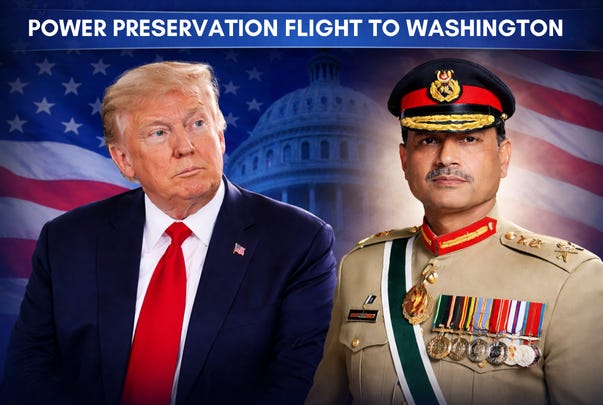
Analysts monitoring civil–military relations and diplomatic developments in Pakistan assess that forthcoming engagement in Washington involving U.S. President Trump and lifetime immunity holder army chief Asim Munir is being closely scrutinized, as it coincides with a U.S.-backed effort to operationalize a post-war Gaza security and stabilization framework. Observers note that this channel has increasingly prioritized direct coordination with Pakistan’s military leadership, raising the decision-making stakes for Asim Munir amid economic constraints and domestic political volatility.
The proposal: a Muslim-majority “stabilization force” for Gaza
Independent political analysts describe the core concept as a multinational force—drawn primarily from Muslim-majority countries—intended to establish a buffer/stabilization presence in Gaza. In this framing, the mission’s practical effect would be to reduce direct exposure and security risk for Israel by inserting third-party forces into the post-conflict governance and security environment. Commentators emphasize that the most contentious operational question is not reconstruction itself, but whether the arrangement implicitly requires containment, dismantling, or “disarmament” of Hamas—an element widely seen as politically toxic for participating states and inherently escalatory on the ground.
Regional reaction: refusals narrow the pool of viable contributors
Analysts monitoring civil–military relations and diplomatic developments in Pakistan assess that forthcoming engagement in Washington involving U.S. President Trump and lifetime immunity holder Army Chief Asim Munir is being closely scrutinized, as it coincides with a U.S.-backed effort to operationalize a post-war Gaza security and stabilization framework. Observers note that this channel has increasingly prioritized direct coordination with Pakistan’s military leadership, raising the decision-making stakes for Asim Munir amid economic constraints and domestic political volatility. Both Indonesia and Pakistan’s Asim–Sharif–Zardari regime face allegations of corruption and human rights violations.
Why Pakistan is a focal point: leverage, incentives, and coercive trade-offs
Commentators assess that Pakistan’s strategic calculus is being shaped by a transactional pressure dynamic: compliance delivers external support, while refusal triggers diplomatic and economic costs. Analysts point to incentives that are routinely extended in return for such alignment, including smoother engagement with international financial institutions, reduced friction in Western diplomatic channels, and sustained political backing for Islamabad’s current governing architecture. In parallel, experts argue that participation results in a marked reduction in international scrutiny of Pakistan’s domestic political environment—including the deliberate overlooking of human rights violations and the military’s open involvement in politics—with contentious governance practices and rights-related criticism effectively set aside, particularly when Pakistan is viewed as facilitating a major U.S. security objective.
Operational risks: rules of engagement, Israel–Hamas friction, and domestic blowback
Security-focused analysts warn that any Pakistan deployment would face three immediate hazards:
Israel–force friction: A foreign contingent operating alongside Israeli forces would likely face strict rules limiting its ability to respond to Israeli actions. Analysts argue this creates a credibility trap: troops may be exposed to confrontation without meaningful agency to respond, increasing reputational and morale risks.
Hamas containment/disarmament dynamics: Analysts emphasize that attempts to disarm or forcibly constrain an entrenched armed actor are not administrative tasks; they are inherently coercive and risk producing direct clashes. Commentators argue a troop presence could be drawn into active conflict rather than “stabilization.”
Domestic political repercussions: Observers underline that Pakistani public sentiment remains strongly pro-Palestinian, and any perception that Pakistani troops are facilitating an Israel-centered security architecture could trigger significant domestic backlash, including mobilization across religious and anti-establishment constituencies. In this context, military agencies have worked intensively in recent weeks to align a Military–Mullah (Islamic scholar) alliance, projecting Asim Munir and the army as a so-called “God’s Army,” while signaling that the alliance will not tolerate dissent or public criticism of Army Chief Asim Munir and his policies. Analysts warn that these dynamics would further strain Pakistan’s already polarized political environment.
The narrowing choice set: internal stabilization versus external compliance
Political analysts conclude that Gen. Asim Munir’s decision is increasingly framed as a constrained choice between two costly tracks:
Align externally by accommodating Washington’s Gaza framework—potentially gaining short-term diplomatic and economic relief, but importing severe domestic risk; or
Resist and delay to reduce internal fallout—accepting potential deterioration in the bilateral relationship at a moment when Pakistan’s economic position increases dependence on external support and diplomatic cover.
Forward outlook: what will define the next phase
Experts argue the key determinant will be whether Pakistan can credibly limit any role to humanitarian logistics and reconstruction support without being operationally tasked—explicitly or implicitly—with enforcement against Palestinian factions. In the absence of a transparent legal mandate, clear command-and-control lines, and public legitimacy at home, analysts assess that any military commitment would carry outsized downside risk for Pakistan’s internal stability, civil–military balance, and regional standing.