

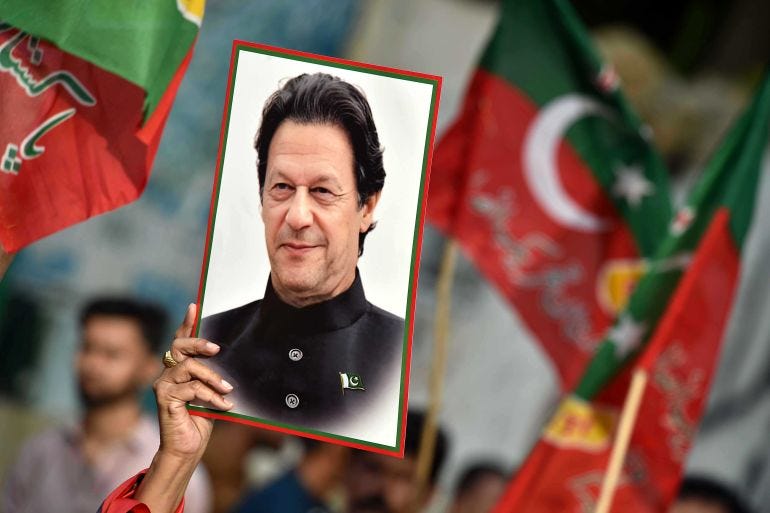
Imran Khan, known worldwide as a celebrated cricketer, could have chosen an easier path, earning significant income through commentary, lectures and writing books, but instead opted for a comparatively difficult road. After the death of his mother, Shaukat Khanum, due to cancer, he decided soon after the 1992 Cricket World Cup that he would establish a cancer hospital in Pakistan where deserving patients could receive treatment free of charge. Initially, medical experts and health professionals dismissed the idea as unrealistic; however, with the establishment of the Shaukat Khanum Memorial Cancer Hospital and Research Centre, thousands of patients over the past several decades have received free or heavily subsidised care, making it a defining symbol of his social vision.
Against this backdrop, Imran Khan decided to enter national politics. He founded a political party named Pakistan Tehreek-e-Insaf (PTI), whose core slogan centred on accountability, transparency and the rule of law. Khan spent much of his education and cricket career in the United Kingdom, giving him some familiarity with Western democratic models and governance practices, but domestically he was confronted with Pakistan’s complex civil–military dynamics, a bureaucracy shaped by colonial legacies, and debates around the “deep state” — all factors that have significantly influenced the country’s politics and foreign policy since independence.
Pakistan’s Politics, Military Eras and Khan’s Opposition-Driven Electoral Politics
In Pakistan, multiple military interventions, including the eras of General Zia-ul-Haq and later General Pervez Musharraf, repeatedly interrupted the political process, leaving an institutional imprint that remains visible today. Even before the attacks of 11 September 2001, General Musharraf had imposed martial law, and the subsequent war in Afghanistan once again positioned Pakistan as a pivotal player in the global security architecture. Earlier, during the Cold War, the history of security cooperation among Pakistan, the United States and Afghan mujahideen in response to the Soviet invasion of Afghanistan had already deeply shaped regional politics.
Political circles have long reported and discussed that General Musharraf, in a meeting, offered Imran Khan a place in his government, an offer Khan did not accept, preferring to maintain an independent political identity. Following a Pakistan Peoples Party (PPP) government, Khan entered parliament with a small number of seats in his first elections, which many observers saw not as the culmination but as the starting point of a long political trial and parliamentary learning curve.
After the Panama Papers revelations, the cases against Nawaz Sharif and his disqualification by the Supreme Court turned the 2018 elections into an unusually contentious episode. A number of domestic and international observers suggested that Khan might even attain a two-thirds majority; however, according to official results he formed what many considered a relatively weak coalition government. Critics levelled allegations of electoral manipulation, engineering and institutional interference in the electoral process. These claims were debated across multiple platforms, but have not been conclusively established through any comprehensive judicial commission, leaving the broader narrative fractured and contested.
Foreign Policy, “Absolutely Not” and the Debate on Alleged Regime Change
During Imran Khan’s tenure, several high-profile foreign policy episodes attracted global attention. In a 2021 interview, he responded “Absolutely Not” to a question about allowing US military bases in Pakistan after the withdrawal from Afghanistan, making clear that his government would not permit a permanent American military presence on Pakistani soil. This stance drew both strong support and criticism at home and abroad and became a central pillar of his narrative of a “sovereign foreign policy”.
Khan’s official visit to Moscow during the Russia–Ukraine war became another major flashpoint, as it took place very close to the start of Russia’s invasion of Ukraine. His supporters argue that the visit aimed at securing discounted oil and gas supplies for Pakistan, while critics describe it as a controversial move that sent a problematic signal to Western allies at a highly sensitive geopolitical moment. In this context, a diplomatic cable (cipher) allegedly linked to US official Donald Lu and to Pakistan’s diplomatic engagement with Washington gave rise to the “regime change” narrative. Khan and PTI repeatedly cited this in explaining his ouster, while the US government and various Pakistani officials strongly rejected the allegations and framed the matter as an internal political crisis.

After Khan’s government was removed through a no-confidence vote in 2022, his supporters framed the event as the product of both external pressure and internal institutional engineering, whereas opposition parties characterised it as a routine exercise of parliamentary democracy under the constitution. As a result, the regime-change debate remains suspended between claims, denials, narratives and perceptions. In the absence of an independent, comprehensive and impartial inquiry, reaching a definitive legal or journalistic conclusion on these allegations is widely viewed as premature and inappropriate.
Economy, Public Pressure and Loss-Making State Enterprises
During Imran Khan’s time in office, various reports pointed to phases of improved growth, higher exports and remittances, and a temporary narrowing of the current account deficit, though economists remained divided on the sustainability of this policy framework and the lack of deeper structural reforms. Critics argued that despite improvements in certain indicators, inflation and unemployment continued to squeeze lower-income groups, prompting opposition parties to organise “inflation marches” and multiple long marches to ratchet up political pressure on the government.
Meanwhile, at the federal level, the 2024–25 fiscal year results for state-owned enterprises (SOEs) revealed that their combined losses had climbed to roughly 832–833 billion Pakistani rupees, while total government financial support to keep them afloat rose to around 2.08 trillion rupees. According to official and media reports, the National Highway Authority (NHA), Quetta Electric Supply Company (QESCO), Peshawar Electric Supply Company (PESCO), Pakistan Railways and PIA Holding were among the entities incurring the heaviest losses, forcing the government to provide continual support through subsidies, guarantees and loans. Economists warn that this trajectory is exacerbating long-term concerns about fiscal sustainability, governance reforms, and the need for privatisation or structural overhaul of these enterprises.
Against this backdrop, the core divergence between government and opposition narratives is that the government attributes SOE losses to legacy policy failures, global economic conditions and energy price shocks, whereas critics highlight alleged corruption, mismanagement and opaque political bargains. Both interpretations, however, underscore the need for independent audits, transparent data and impartial policy reviews — an agenda on which meaningful progress remains limited to date.
Judiciary, Prosecutions and Growing Concern over Imran Khan’s Health
Over the past several years, more than two hundred cases have been registered against Imran Khan, with courts later granting relief or disposing of a number of them on grounds such as acquittal, bail or lack of prosecution. Khan’s lawyers and supporters maintain that many of these cases are politically motivated, while the government and rival parties describe them as lawful processes aimed at ensuring accountability and upholding the rule of law. Recent constitutional amendments and changes in the judicial framework have further fuelled debate over whether the courts can operate fully independently and maintain distance from centres of power, with constitutional experts offering divergent views.

In recent weeks, reports about Imran Khan’s health — particularly his eyesight — have raised serious questions in domestic and international media. According to court filings and medical reports, Khan complained of pain and blurred vision in one eye in late 2025. Subsequent delays in treatment, according to his legal team, led to a blood clot in his right eye, leaving him with an estimated 85 percent loss of vision and only about 15 percent sight remaining in that eye. An ophthalmologist’s report submitted to the court diagnosed a central retinal vein occlusion and noted that, despite treatment including an injection, the damage appears to be partly permanent.
In February 2026, Pakistan’s Supreme Court expressed concern over the situation and directed the government to arrange an immediate and comprehensive medical examination, ensure access to specialist eye doctors, facilitate contact with Khan’s personal physicians, and allow him telephone conversations with his sons. Government representatives insist that the best available medical care is being provided and argue that there is no concrete evidence to substantiate allegations of deliberate malpractice or ill intent by the medical staff.


By contrast, Khan’s lawyers and family say that his complaints were not addressed promptly, that he has faced prolonged difficulties in meeting his counsel and relatives, and that an independent, transparent medical board — including his personal doctors — is essential. On social media and in public debate, some commentators question the nature of the blood clot and the quality of food and healthcare in prison. However, these concerns have not been independently verified through any judicial or investigative process and should therefore be treated as conjecture or expressions of concern rather than established fact.