
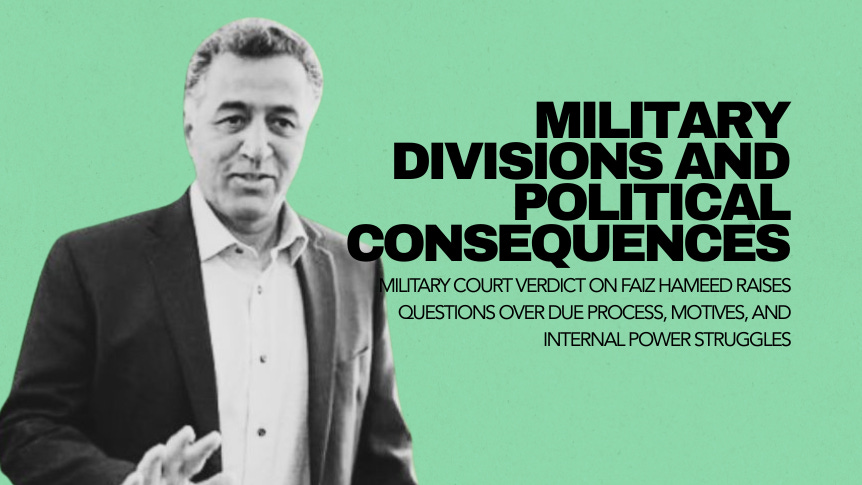
The 14-year sentence issued to former Pakistan Army intelligence chief Faiz Hameed marks a rare moment in the country’s civil–military landscape, yet experts tracking institutional dynamics note that the outcome reflects widening internal rifts rather than structural reform. Analysts familiar with the December proceedings emphasize that the process—opaque, informally communicated, and selectively targeted—does not indicate any systemic shift toward accountability. Instead, it underscores how factional competition within the military establishment has come to shape major institutional decisions.
The historically documented rivalry between senior military factions provides essential context. Analysts note that the earlier displacement of one intelligence chief in favour of another during the previous Imran Khan civilian administration became a key inflection point that generated lasting institutional bitterness. The latest sentencing appears to represent the culmination of this unresolved internal contest, where disciplinary action is deployed not as a governance doctrine but as a tool of intra-elite consolidation.
This internal fragmentation matters for Pakistan’s wider political system. When top-tier military cohesion weakens, policy becomes reactive, unpredictable, and highly personalised—undermining the stability that the institution publicly claims to guarantee.
Optics vs. Reality: A Case Built for Narrative, Not Reform
Independent political analysts reviewing the available case details note a striking gap between public messaging and procedural substance. Official communication emphasizes punishment for political interference, misuse of authority, and breaches of secrecy. Yet the manner in which the verdict was delivered—reportedly through informal channels, without summoning defence counsel or family for formal pronouncement—raises questions about due process.
Media commentators also highlight that the most politically explosive component, “interference in politics,” was presented without calling any witnesses from political parties, diplomatic circles, or the military cadre—despite documented patterns of multi-actor involvement in political engineering over several electoral cycles. Evidence offered by the defence to compel a broader fact-finding process was reportedly not taken up.
More: Pakistan’s Economic Breakdown Deepens as Political Engineering Dominates State Priorities
The outcome has produced a case that, according to analysts, appears structurally limited by design. It allows the military institution to signal internal corrective action without creating any precedent that might implicate additional senior officials or expose the broader mechanisms of political management used over recent years. In practical terms, the decision strengthens narrative control—projecting an image of accountability—while leaving the underlying system and its operational methods unchanged.
Institutional Politics: Selective Accountability to Preserve the Core
Experts on Pakistan’s civil–military dynamics consistently note that the security establishment has never subjected itself to full and transparent accountability for political interference. From the eras of Ayub Khan, Yahya Khan, Zia-ul-Haq, Pervez Musharraf, Qamar Javed Bajwa to the present leadership under Asim Munir, the pattern has remained largely unchanged. Instead of institutional reform, the military periodically deploys selective disciplinary actions to ease public pressure while preserving its overarching authority. Historically, most of these military rulers or power brokers also maintained close ties with the United States during their tenure, reinforcing their external legitimacy even as domestic political oversight remained absent.
This latest episode closely follows the familiar pattern. By isolating a single high-profile figure while avoiding scrutiny of the wider networks involved in political decision-making across multiple administrations, the system preserves the strategic autonomy of the military hierarchy. The absence of any co-accused—despite the clear operational reality that large-scale political interference cannot be executed by one officer without coordinated support from ISI and Military Intelligence—indicates an intentional narrowing of responsibility. It is self-evident that Faiz Hameed could not have carried out these actions alone.
Simultaneously, the current military leadership’s prior legal self-exemption underscores how institutional politics operate: power holders secure insulation before sanctioning punitive actions against rivals. This approach reinforces vertical discipline while discouraging horizontal accountability across ranks.
Seen through a policy lens, the case reflects how Pakistan’s governance challenges stem not merely from civilian weakness but from structurally embedded incentives within the military to avoid institutional transparency.
Impact on Imran Khan: Why This Case Cannot Form a Legal Bridge
While some political actors frame the sentencing as a precursor to a potential military trial of Pakistan’s former prime minister, analysts examining legal and political constraints find little basis for such an extension.
From a legal perspective, a prime minister is inherently the central recipient of classified briefings, making “secrecy violations” extremely hard to apply. Earlier attempts to frame charges around diplomatic communications have already been dismissed by civilian courts. Without a robust evidentiary chain linking the two figures—particularly given that the current case avoided calling witnesses from political parties or the security apparatus—there is no substantive legal basis for military prosecution.
Politically, experts note that transferring a former elected premier to a military tribunal would provoke significant domestic unrest and international resistance. Such a move would only become possible if the United States and the European Union were to give tacit approval to Pakistan’s security establishment; without that quiet green light, strong objections on human-rights grounds would be expected. Throughout the past year, authorities have avoided presenting him in open civilian courts due to overwhelming public pressure. The political cost of shifting him into a military court would be exponentially higher.
For these reasons, observers conclude that while the case may function as a narrative device suggesting a broader crackdown, it does not provide a credible pathway to prosecute the former prime minister Imran Khan within the military justice system.
What This Episode Reveals About Pakistan’s Trajectory
The sentencing has not reinforced institutional legitimacy; instead, it has exposed systemic fragilities. Analysts note that the civil–military imbalance remains intact, as no civilian institution oversaw or influenced the process, leaving accountability solely in military hands. Rising intra-establishment tensions increase the risk of incoherent policymaking during a period of economic strain and diplomatic pressure. A two-tier justice system—where senior military figures receive comfortable conditions while political detainees face harsh treatment—erodes public confidence in the rule of law. Meanwhile, political engineering and internal power contests continue to drain institutional capacity for economic reform, weakening Pakistan’s leverage in future IMF negotiations. Ultimately, the selectively constructed, easily reversible nature of the case signals that the system remains resistant to structural reform, keeping accountability personalised rather than institutionalised.