
From Governance Failure to Economic Fragility: IMF Confirms Pakistan’s Systemic Corruption and Military-Linked Market Distortions - PolicyTalk Examines How Elite Capture and Militarised Economics Shape the Crisis
In 2026 under Asim, Sharif Zardari regime Pakistan today stands at a critical juncture where economic insolvency, institutional erosion, and civil–military imbalance have converged into a structural governance crisis. The IMF Governance and Corruption Diagnostic Assessment (GCD), released in late 2025, provides one of the most authoritative, evidence-based confirmations that:
Corruption is systemic, not episodic.
Elite capture dominates the state, shaping legislation, resource allocation, and economic decision-making.
Accountability institutions are politicised, selective, and structurally incapable of addressing high-level corruption.
The economy is heavily state-dominated, with an extraordinary share of wealth, land, and enterprises under state or state-linked control.
Military-linked institutions form a significant component of that economic dominance, yet operate with limited public transparency.
Pakistan’s economic sovereignty has weakened, as key fiscal decisions require IMF approval due to internal governance failures.
This report synthesises the IMF’s findings, economic data, and open-source analysis, demonstrating that these problems are not abstract policy deficiencies but foundational structural failures deeply embedded in Pakistan’s political economy.
Report Source: HIGH-LEVEL SUMMARY TECHNICAL ASSISTANCE REPORT
1. Introduction
For decades, Pakistan’s governance model has been characterised by:
A fragmented civilian state
A powerful civil-military bureaucratic apparatus
Weak, controlled and compromised accountability bodies
An oligarchic political and economic elite
A tax regime designed to protect powerful groups
An SOE sector whose size exceeds most developing economies
The IMF’s Governance & Corruption Diagnostic Assessment—a document Pakistan was required to publish as part of its IMF programme—provides unprecedented transparency on the scale and structure of institutional corruption.
This report positions the IMF assessment within the broader context of Pakistan’s political economy, military involvement, and state fragility.
2. IMF Governance & Corruption Diagnostic: Key Findings
The IMF’s GCD identifies six governance pillars requiring urgent reform:
Fiscal governance
Market regulation
Financial-sector oversight
Anti-money laundering
Rule of law, property rights
Accountability institutions
Across all six, the IMF identifies persistent structural failures, including:
2.1 Systemic Corruption
Pakistan loses trillions of rupees annually in leakages, exemptions, and institutional inefficiencies.
NAB’s recoveries for 2023–24 stand near PKR 5 trillion, but due to low verification and conviction rates, this represents only a fraction of the true corruption volume.
No reliable state mechanism exists to measure total corruption—an explicit IMF finding.
2.2 Elite-Driven Economic Architecture
The IMF confirms:
Elite tax exemptions and preferential treatment distort markets and suppress development.
Large sectors—including real estate, sugar, and commodity cartels—benefit from privileged access, subsidies, or legal protections.
Pakistan forfeits roughly 6% of its budget to elite privileges and tax exemptions.
2.3 State-Dominated Economy
SOEs control assets equal to ~44% of GDP, far above global norms.
Around half of SOEs are loss-making, draining fiscal resources.
Banks overwhelmingly lend to the government or state-linked entities rather than to private enterprise.
2.4 Weak Rule of Law
Courts face massive backlogs:
56,000 cases pending in Supreme Court
Thousands more in High Courts
Millions in district courts
Enforcement of financial contracts is weak, unpredictable, and often influenced by elite interests.
As of December 2024, the total number of registered cases against Imran Khan across Pakistan was reported to be 188. ARY News
In the capital Islamabad alone, around 74 cases were reportedly filed against him; in Punjab about 99 cases, and some (fewer) in Khyber Pakhtunkhwa. Dunya News
According to a report delivered to the Islamabad High Court, 7 cases/inquiries against him were pending before the Federal Investigation Agency (FIA), and 3 cases under the National Accountability Bureau (NAB). The Express Tribune
Additionally, as of late 2024, it was broadly stated that he was facing “over 186” political motivated cases.
2.5 Politicised Accountability
The IMF explicitly highlights:
NAB and FIA lack impartiality and consistency.
Auditor General produces thousands of reports ignored by ministries and the Public Accounts Committee.
Parliamentary oversight has collapsed; key committees remain non-functional.
3. Military Involvement in the Economy: Structural Evidence
While the IMF report maintains institutional neutrality, multiple public, internationally verified sources show that:
The military’s economic footprint is one of the largest among Pakistani institutions.
Foundations linked to the armed forces—such as the Fauji Foundation, Army Welfare Trust, Shaheen Foundation, and Bahria Foundation—collectively operate dozens of businesses, from fertiliser and cement to banking, energy, cereal production, and real estate.
Independent reporting recognises the Fauji Foundation as Pakistan’s largest business conglomerate, valued at around USD 6 billion.
Military-linked housing schemes (e.g., DHA) control land in nearly every major city.
3.1 Asset Declarations: Unequal Transparency
As part of IMF programme conditions, Pakistan agreed to expand public officials’ asset declarations.
However:
Military personnel and judicial officers were exempted in the official rules, despite their central roles in Pakistan’s governance landscape.
This exemption undermines:
Accountability
Public trust
Transparency standards expected under democratic norms
It also reinforces the conclusion that elite capture includes military-linked institutions, not merely civilian bureaucratic and political actors.
4. Loss of Economic Sovereignty
The GCD demonstrates that Pakistan’s governance failures have made the country dependent on IMF oversight for:
Fuel price adjustments
Gas tariffs
Development spending
Borrowing decisions
Debt restructuring
SOE reforms
This is not external coercion—it is a direct outcome of internal institutional collapse.
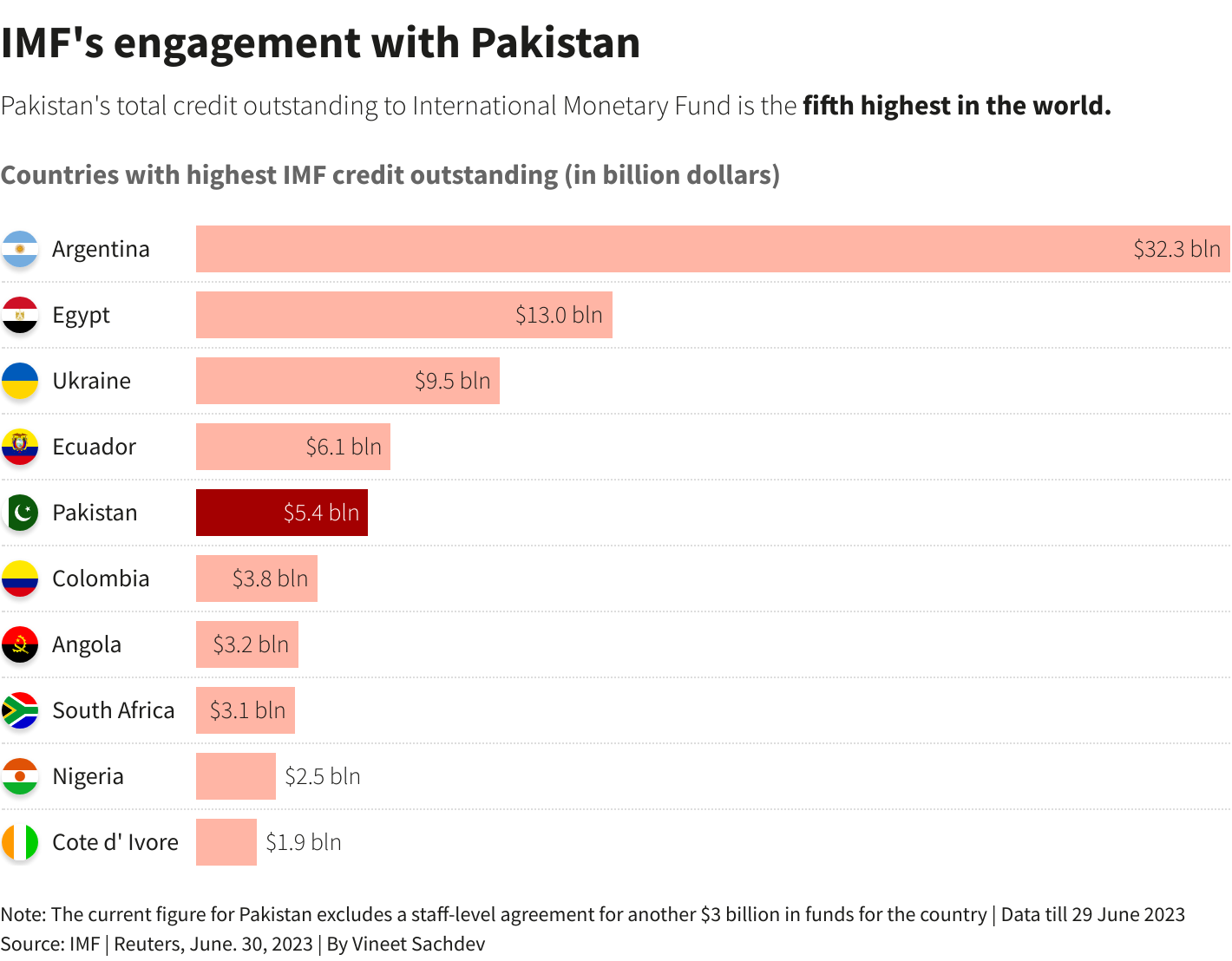
Pakistan has entered its 25th IMF programme, more than almost any other country, reflecting long-term structural misgovernance.
5. Socioeconomic Outcomes: The Human Cost
5.1 Youth Unemployment & Brain Drain
Pakistan’s youth unemployment has reached alarming levels.
Nearly 1 million degree holders leave Pakistan annually due to lack of trust in economic institutions.
Employment creation remains stagnant, largely because private-sector investment is suppressed by elite-controlled, state-heavy economic structures.
5.2 Gendered Economic Exclusion
Only 1 in 4 women participate in the labour force.
IMF notes the severe economic cost of excluding half the population from production.
5.3 Underfunding of Health & Education
Despite extreme poverty levels:
Pakistan spends under 1% of GDP on health.
Education spending remains far below South Asian averages.
Meanwhile, elite groups benefit from tax exemptions equal to 4–6% of the budget.
5.4 Collapse of Public Service Delivery
Pakistan’s bureaucracy is identified by the IMF as:
A central actor in rent-seeking
Resistant to reform
Fragmented and unaccountable
Politically shielded and structurally dominant since 1947
6. Militarisation of Civilian Policy-Making
Although the IMF does not name specific actors, independent reports confirm a trend:
The Special Investment Facilitation Council (SIFC), which oversees major investment decisions, includes strong military representation.
Foreign investors increasingly seek assurances from the military leadership, indicating the imbalance between civilian and military authority.
Key areas of economic governance, land allocation, and mega-project decisions are influenced by military-linked institutions.
This is a hallmark of a hybrid governance system, where democratic institutions formally exist but real authority is diffused across unelected actors.
7. How the IMF Report Validates Pakistan’s Reality
The IMF report is powerful not because it introduces new allegations—it is powerful because it confirms, with formal international documentation, what Pakistani society has experienced for decades:
Corruption is structural, not personal.
State capture is entrenched, not incidental.
The military-bureaucratic establishment is economically dominant, not merely politically influential.
Civil institutions are hollow, not dysfunctional by accident.
Economic decisions are made by a narrow elite, not representative institutions.
IMF oversight has become necessary, not optional, because of domestic institutional failure.
This alignment between IMF evidence, public experience, and independent analysis makes the report a solid foundation for international understanding and diplomatic engagement.
8. Implications for International Partners
Foreign governments, multilateral organisations, and human-rights bodies should recognise the following:
8.1 Pakistan’s Crisis is Governance-Driven
This is not a cyclical downturn—it is a structural crisis rooted in:
Elite capture
Militarised policy-making
State-dominated economy
Collapse of oversight institutions
8.2 Economic Assistance Requires Governance Conditions
IMF’s report signals that:
Aid, loans, and foreign investment will remain ineffective without governance reforms.
Privatisation, debt restructuring, and fiscal stabilisation will fail unless transparency improves.
8.3 Human-Rights and Governance Are Linked
The GCD reveals:
Discriminatory accountability
Unequal access to justice
Non-functional legislative oversight
Corruption that deprives millions of basic rights
These are human-rights issues, not merely economic inefficiencies.
8.4 Civil–Military Imbalance Must Be Addressed Diplomatically
The international community must:
Recognise the economic dimension of military influence
Encourage transparency in military-linked enterprises
Promote equal accountability for all state institutions
9. Recommendations for International Actors
Align future financial assistance with governance benchmarks, especially transparency and equal accountability.
Support Pakistan’s parliamentary and judicial reform efforts, focusing on institutional independence.
Encourage public disclosure of military-linked economic activities, consistent with global norms.
Engage with civil society and independent media to strengthen governance literacy.
Support frameworks that increase female labour force participation and youth employment.
Require transparent reporting of all SOEs, including military-linked foundations.
10. Conclusion
The IMF has delivered a historically significant document.
It confirms what many inside Pakistan have long argued:
The state is dominated by a small coalition of military, bureaucratic, political, and economic elites whose collective incentives undermine governance, accountability, and economic stability.
Until Pakistan breaks this cycle of elite privilege and militarised economic control, no IMF programme, no bailout, and no foreign investment will deliver sustainable recovery.