

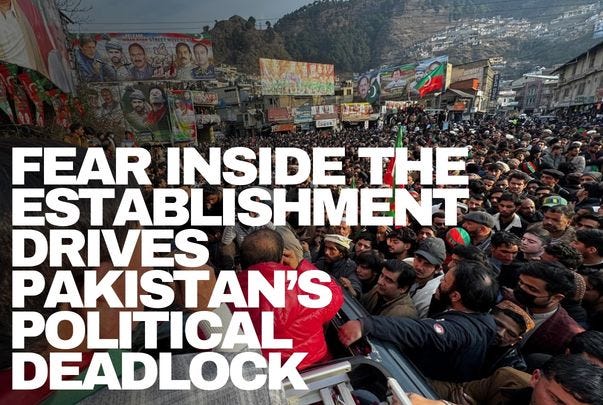
ISLAMABAD — Pakistan’s political tensions are escalating again as the opposition Pakistan Tehreek-e-Insaf (PTI) moves toward street mobilisation, amid deepening military involvement in politics and election engineering, while the military-backed government struggles to revive stalled dialogue.
The latest flashpoint has emerged in Khyber Pakhtunkhwa, where Chief Minister Sohail Afridi has taken a public role in mobilising supporters, portraying the push as resistance to what many Pakistanis describe as military influence over the political system. Supporters say the movement reflects growing public anger over military-backed governance, economic decline and restrictions on political participation following the 2022 change of government, which PTI leaders and supporters have linked to the removal of Imran Khan after a diplomatic cable involving then army chief Qamar Javed Bajwa and U.S. official Donald Lu.
Street pressure builds
PTI supporters say attempts were made by the military establishment to limit Chief Minister Sohail Afridi’s public outreach in sensitive areas of Khyber Pakhtunkhwa, citing security concerns and administrative obstacles. Afridi proceeded with the engagements, later drawing large crowds across several districts. Party officials have described the gatherings as a display of political momentum at a time when formal political avenues remain constrained.
Political analysts say street mobilisation has become PTI’s primary source of pressure after repeated efforts at dialogue with the ruling coalition failed. They note that PTI leaders reject negotiations on the grounds that the Pakistan Muslim League-N (PML-N) and the Pakistan Peoples Party (PPP) lack an independent electoral mandate due to the military’s role in political management — a conclusion echoed in assessments by international observers, including the European Union’s election observation mission following Pakistan’s 2024 vote. Analysts add that sustained protest movements in Pakistan typically depend on strong local organisation and at least tacit tolerance from security agencies — conditions that remain uncertain.
May 9 Cases Block Political Dialogue
Efforts to revive political dialogue have repeatedly faltered, with the ruling Pakistan Muslim League-N offering talks to Pakistan Tehreek-e-Insaf since late 2024 but failing to bridge fundamental differences. PTI insisted that any negotiations be preceded by concrete steps, including independent judicial commissions to investigate the May 9, 2023 violence, the release of political prisoners, and unrestricted access to jailed former prime minister Imran Khan. Those conditions were not met, and multiple rounds of talks ended without agreement. Opposition figures say the collapse reflects a deeper structural issue, arguing that civilian leaders lack the authority to make binding political decisions, while government officials maintain the talks failed due to irreconcilable positions.
The May 9 cases remain central to the deadlock. Khan has been in custody since 2023 in cases ranging from corruption to charges linked to unrest following protests in which military installations were attacked. Authorities describe the prosecutions as national security matters, while PTI maintains they are politically driven. Khan has repeatedly called for an independent judicial inquiry and the public release of CCTV footage from the incidents, alleging the footage was removed and that those responsible orchestrated the violence. Nearly three years later, no independent investigation has been launched, courts have upheld multiple indictments, and appeals remain pending.
Debate Over Youth Vote Fuels Power Fears
Adding to tensions is a growing debate over proposals to alter electoral rules, including raising the voting age from 18 to 25 — a move that many observers say reflects deep anxiety within Pakistan’s deep state and military establishment over youth participation. Analysts argue that young voters overwhelmingly support Imran Khan and that a large-scale youth turnout would fundamentally disrupt the political order built and sustained over decades by the military establishment. In this view, restricting the youth vote is seen not as electoral reform but as an effort to shield an entrenched power structure from collapse. While no legislation has been introduced, the debate itself has reinforced perceptions of election engineering and heightened concerns that democratic participation is being deliberately curtailed.
A familiar cycle
Analysts say Pakistan appears trapped in a recurring pattern: a jailed opposition leader commanding popular support, a government facing questions over its mandate, and a military institution accused — again — of shaping political outcomes from behind the scenes.
Whether the confrontation shifts back to negotiations or escalates into sustained street protest will depend on how far mobilisation spreads and whether political authority is allowed to operate independently of security influence.
For now, the stalemate holds — and the distance between the street and the state continues to widen.