
News Summary:
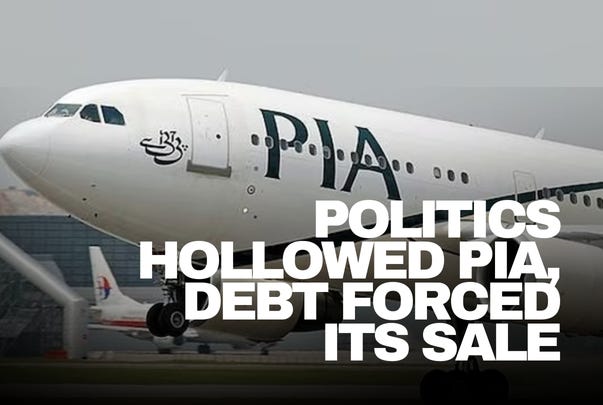
Islamabad - Pakistan has completed the long-delayed privatization of its national carrier, Pakistan International Airlines (PIA), in a deal the government has described as transparent and reform-driven, but which critics say reflects deep fiscal distress, weak investor confidence, and the expanding role of military-linked capital in the country’s economy.
The airline was sold for 135 billion Pakistani rupees ($450 million) to a local consortium led by the Arif Habib Group following a live, televised bidding process. The government retained a 25% stake, with the buyer holding an option to acquire the remainder within a year at a premium.
No international airline or foreign strategic investor participated in the bidding.
From Regional Pioneer to Fiscal Burden
Founded in 1955, PIA was among Asia’s earliest national airlines and remained profitable for nearly four decades. Through the 1960s, 1970s, and much of the 1980s, it operated as a regional pioneer, supplying technical staff and training that later helped establish airlines such as Emirates and Singapore Airlines.
Industry analysts and former executives date PIA’s structural decline to the early 1990s, when successive governments began using the airline for political hiring, allocating routes based on patronage rather than profitability, and imposing price controls that distorted commercial decision-making.
Public audit records and parliamentary reports show that by the late 1990s, PIA had become chronically loss-making, requiring repeated government bailouts.
How Political Hiring Broke the Airline
A review of parliamentary proceedings, auditor-general findings and aviation data shows that PIA’s deterioration followed a pattern common to several state-owned enterprises in Pakistan.
In the mid-1980s, PIA operated roughly 45–50 aircraft with an estimated 18,000–20,000 employees, producing an employee-to-aircraft ratio of about 400:1, broadly in line with global norms at the time.
That balance shifted after 1989, following Pakistan’s return to competitive civilian politics.
Between 1989 and 1993, under the first civilian governments of Benazir Bhutto and Nawaz Sharif, hiring accelerated in clerical, ground-handling and non-technical roles, often based on political recommendations rather than operational need. By 1993, analysts estimate staff numbers had risen to 23,000–25,000, with little change in fleet size.
The trend intensified between 1993 and 1999, when contract and temporary workers were widely regularised ahead of elections and politically aligned unions gained influence over management. By the late 1990s, PIA employed more than 30,000 staff for a fleet of 40–45 aircraft, pushing the employee-to-aircraft ratio to 650–750:1.
After the 1999 Musharraf military takeover, large-scale political hiring slowed but was not reversed. Workforce reductions were avoided due to political and social resistance, and losses continued to be absorbed by the state.
The most damaging phase came after 2008, under successive governments of the Pakistan Peoples Party (PPP) and the Pakistan Muslim League-Nawaz (PML-N). Employee numbers peaked at 45,000–50,000, while operational aircraft fell below 35, many grounded for maintenance. The employee-to-aircraft ratio exceeded 1,000:1.
For comparison, major international full-service airlines typically operate with 150–250 employees per aircraft.
“No airline can survive with that cost structure,” said a former civil aviation regulator. “By that point, the losses were built in.”
Losses Socialised, Assets Sold
By the 2010s, PIA required repeated government bailouts to meet payroll and debt obligations. Auditor-general reports show cumulative losses running into hundreds of billions of rupees, largely absorbed through sovereign guarantees.
Despite multiple reform attempts, no government pursued large-scale restructuring, citing labour unrest and political fallout.
Fleet Value and the Price Debate
PIA currently lists 34–38 aircraft on its books, though only 18–20 are operational, according to aviation tracking data and company disclosures.
Industry pricing databases show that in today’s secondary market:
Used Boeing 777-200/300ER aircraft typically trade between $20–40 million,
Airbus A320-family aircraft between $15–30 million,
ATR turboprops between $5–10 million.
On a conservative basis, analysts estimate PIA’s operational fleet value at $350–500 million, before factoring in landing slots at major airports, bilateral air service rights with more than 90 countries, brand value, and ground infrastructure.
That arithmetic has fueled debate over whether $450 million fully reflects the airline’s underlying assets, even excluding hotels and real estate that were retained by the state.
Why Foreign Investors Stayed Away
After the privatization of PIA, contradictory statements emerged from within the government itself.
Some government officials argued that Pakistan’s aviation market failed to attract foreign airlines due to regulatory complexity and PIA’s long history of losses, suggesting that the absence of international bidders was structural rather than political.
However, Pakistan’s Defence Minister Khawaja Asif offered a sharply different interpretation, saying the privatization of PIA demonstrated growing confidence by foreign investors in the Pakistani government, a claim that stood in contrast to the exclusively domestic nature of the bidding process.
Independent analysts point instead to broader concerns, including:
political instability following Pakistan’s regime change,
weak enforcement of the rule of law,
currency volatility,
and opaque civil–military decision-making structures.
“These deals don’t fail on valuation alone,” said a Karachi-based investment banker. “They fail on trust.”
The contrast between the privatization of Air India and Pakistan International Airlines is stark. Air India’s sale to the Tata Group transferred meaningful operational risk to the buyer, included the assumption of significant liabilities, attracted competitive bidding, and was framed around reviving a national asset. By contrast, PIA’s sale to a consortium led by the Arif Habib Group largely ring-fenced historical debt and pension obligations with the state, drew no foreign airline bidders, and delivered limited immediate fiscal relief. As a result, analysts say Air India was privatized to rebuild an airline, while PIA was privatized primarily to halt losses — with much of the burden remaining on taxpayers.
Military-Linked Capital and Strategic Gain
The winning consortium has indicated it may bring in additional partners, including entities linked to Pakistan’s military-run commercial enterprises.
Economists note that such firms stand to benefit from:
low-risk entry into a strategic asset backed by state guarantees,
reinvestment-only profit restrictions that limit political backlash while preserving long-term control,
preferential access to aviation infrastructure and state contracts.
Pakistan’s armed forces already control extensive commercial interests across banking, real estate, fertilizers, and logistics, making PIA a potential extension of that portfolio rather than a conventional privatization.
Competing Narratives
Government ministers have framed the transaction as a successful reform that exceeded internal valuations and halted annual losses.
Critics, including journalist Imran Riaz Khan, argue the structure transfers future upside to the buyer while leaving liabilities — including pensions, taxes, and historical debts — with the state.
“The government sold control but kept the burden,” Khan said in a broadcast commentary.
The buyer says PIA’s potential lies in religious travel, the overseas Pakistani market, and underutilised international slots — advantages it argues governments failed to exploit due to bureaucratic constraints.
A State Under Financial Duress
Pakistan’s broader fiscal position looms over the deal. Public debt exceeds 80% of GDP, with external obligations heavily concentrated over the next five years. Islamabad remains under a multi-year stabilisation programme with the International Monetary Fund, requiring asset sales, subsidy cuts and structural reforms.
Government officials say privatization is unavoidable.