
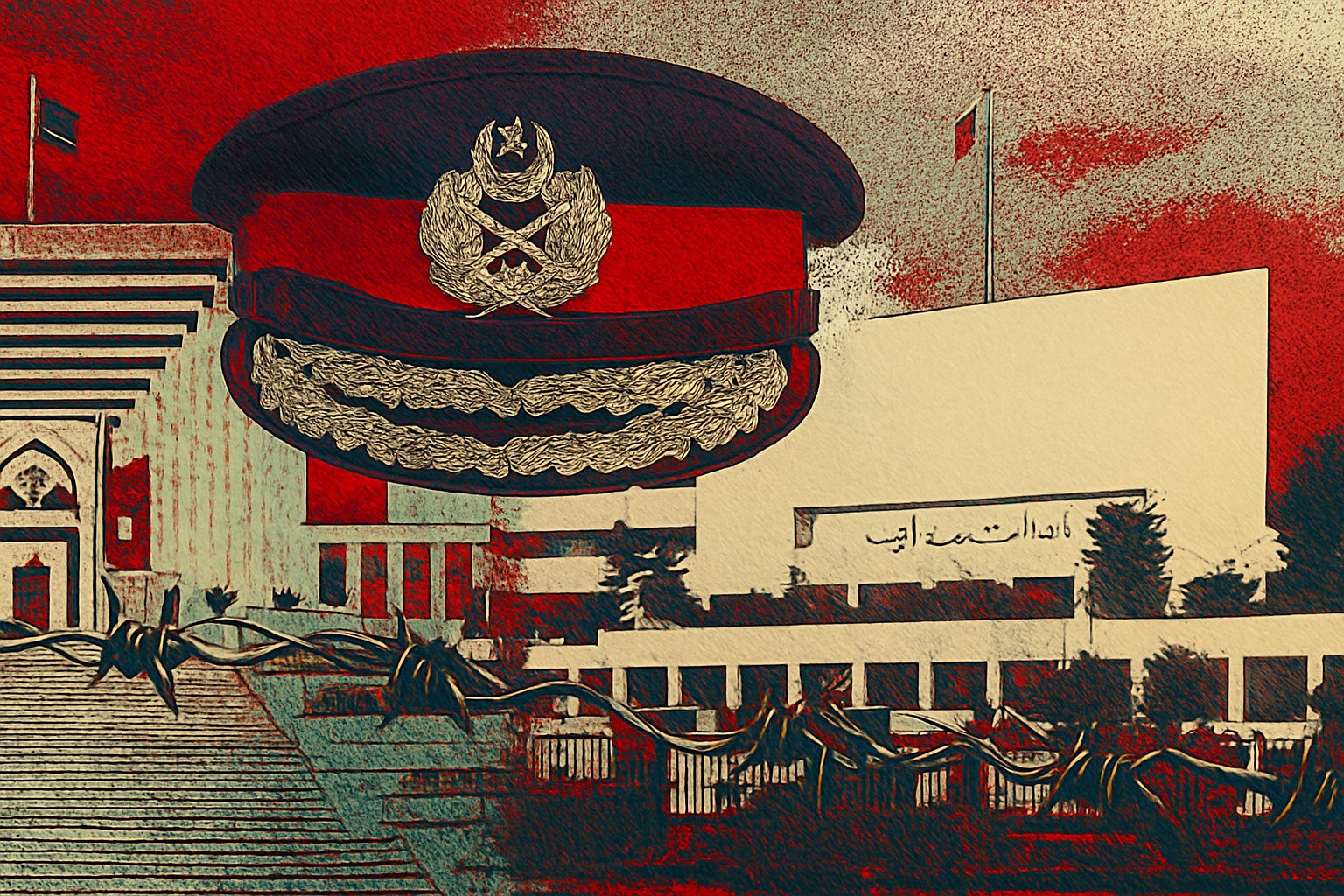
ISLAMABAD — Pakistan is entering a deeper phase of political confrontation amid sweeping constitutional changes, expanding military authority, and escalating anxiety over the detention and possible relocation of former Prime Minister Imran Khan. Analysts increasingly argue that Pakistan is not simply at risk of authoritarian drift — rather, the core democratic and judicial structures have already been significantly weakened and dismantled.
Recent political restructuring has consolidated unprecedented authority in the hands of Army Chief General Asim Munir, who now simultaneously holds the posts of Chief of Army Staff, Chief of Defence Forces, and — under newly passed legal provisions — enjoys lifetime immunity from prosecution. Many political commentators and legal experts say these shifts reflect not an emerging trend but an established reality: the military has entrenched itself as the dominant centre of power, overshadowing both Parliament and the judiciary.
Power Has Already Shifted Away from Parliament, Analysts Say
Following the 26th and 27th Amendments, Pakistan’s governance framework underwent a substantial transformation. Analysts widely note that these reforms have already moved Pakistan away from parliamentary supremacy. The proposed 28th Amendment — still pending — is therefore seen not as a dramatic future change but as a continuation of a process that has effectively placed key functions of the state under an executive-aligned, institutionally concentrated structure.
Legal observers argue that the independence of the judiciary has been severely compromised since the 27th Amendment, which reconfigured judicial appointments and internal court procedures in ways critics say have brought judicial decision-making closer to government and military influence. For many, the question is no longer whether the judiciary might lose independence, but whether any meaningful independence remains.
If enacted, the next amendment would allow federal authorities or designated institutions to extend emergency powers or impose long-term Governor’s Rule in opposition-led provinces. Analysts say these mechanisms would formalize powers that, in practice, are already tilted toward the centre.
Growing Alarm Over Imran Khan’s Safety and Isolation
Imran Khan has been held at Adiala Jail since August 2023 after his removal from office and a series of convictions his party rejects as politically motivated. Crucially, since the start of his incarceration, no photograph, video, or audio evidence of his well-being has been released — an unprecedented level of secrecy for a former prime minister.
Reports suggest that internal discussions are underway about transferring Khan to one of several high-security prisons, including Sahiwal Jail, known for holding terrorism-related detainees. The lack of transparency surrounding these deliberations has intensified concerns.
Last week, unverified rumours circulating from Afghanistan-based social media accounts falsely claimed Khan had been killed in custody. These claims spread rapidly in part because Pakistani authorities have not permitted Khan’s family to meet him for nearly a month, despite repeated court orders enforcing visitation rights.
Political analysts say the restriction of access, absence of visual verification, and secrecy about his detention conditions contribute to a widespread perception that the state is deliberately isolating Khan. Some political figures allege that elements within the establishment and the Sharif family seek to permanently eliminate him as a political force — claims for which no official confirmation exists but which continue to fuel public distrust.
Governor’s Rule in KP Seen as Part of a Larger Centralization Strategy
In parallel, the army-backed federal government is considering imposing Governor’s Rule in Khyber Pakhtunkhwa (KP), the core base of Pakistan Tehreek-e-Insaf. Under Articles 232 and 234, such a move would suspend the elected provincial government and transfer authority to a centrally appointed governor with close ties to the military.
Experts note that, in earlier years, Governor’s Rule was discussed as an extraordinary step. Today, many observers argue it has become part of a broader governance pattern in which provincial autonomy is subordinated to central authority.
If the 28th Amendment is passed, Governor’s Rule could be legally extended far beyond the current two-month limit, formalizing the central government’s ability to exercise prolonged control over KP. Analysts say this would not only undermine federalism but deepen long-standing resentment in a province where anti-establishment sentiment has grown sharply in recent years.
Senator Faisal Vawda, viewed as aligned with military leadership, recently stated that “after Governor’s Rule, the army will carry out major operations in KP.” His remarks have heightened fears of confrontation between security forces and local populations.
Observers: Pakistan Has Already Crossed a Democratic Threshold
Pakistan appears to be moving beyond a debate about whether democratic institutions are weakening. A growing number of political analysts and legal scholars now argue that the country has already entered a phase where:
– the judiciary’s structural independence is compromised,
– Parliament’s authority is significantly diminished,
– military dominance is formalized rather than informal,
– and elected provincial governments can be overridden through constitutional engineering.
Analysts warn that these developments do not merely represent a risk to democracy but evidence of a political system that has shifted toward centralized, managed governance with minimal space for electoral accountability or dissent.